Saudi Arabia's events industry has transformed faster in the past five years than in the previous three decades. The convergence of Vision 2030 mega-programmes, a liberalised entertainment sector, and surging business tourism has created a professional events market that now demands world-class operational standards.
Yet many event organisers in the Kingdom still manage registrations through spreadsheets, distribute pre-printed badges through manual sorting, and have no visibility into real-time attendance during the event itself. This gap between expectation and execution is where professional event management technology makes the biggest difference.
This guide covers every major dimension of professional event management in Saudi Arabia — from permit applications through post-event reporting — with specific focus on the technology decisions that separate successful events from costly operational failures.
Saudi Arabia Events — Key Numbers
500+
Annual Events KSA
2M+
Attendees Managed
98%
Satisfaction Rate
40+
Cities Covered
Saudi Event Landscape
Saudi Arabia's events sector now spans over 500 major events per year across more than 40 cities and regions. The event mix is unusually diverse by global standards: it ranges from international music festivals and sporting championships to religious conferences, government summits, corporate exhibitions, and cultural heritage experiences.
Vision 2030 directly drives this expansion through the General Entertainment Authority (GEA), which has licensed thousands of new entertainment activities since 2016. NEOM, Diriyah Gate, AlUla, and the Red Sea Project are creating entirely new event destinations that require event management infrastructure built from scratch.
Growing Event Categories
- International conferences & summits
- Cultural & heritage festivals
- Sporting events & championships
- Corporate exhibitions & trade shows
- Government & official ceremonies
Key Event Locations
- Riyadh — conferences, exhibitions, government
- Jeddah — entertainment, sports, cultural
- AlUla — heritage, luxury, equestrian
- NEOM — innovation, technology, lifestyle
- Diriyah — heritage, arts, culture
Planning Framework
Professional event management in Saudi Arabia follows a five-phase framework. The phases are sequential, but technology setup spans multiple phases — beginning earlier than most organisers expect.
Phase 1 — Concept & Approvals
6–12 months outDefine event objectives, secure venue, identify key stakeholders, and begin permit applications with the General Entertainment Authority (GEA), Ministry of Commerce, or relevant government bodies depending on event type.
Phase 2 — Registration & Accreditation Setup
3–6 months outLaunch the registration portal, configure attendee categories, set up approval workflows, and design badge templates. StampIQ's platform can be fully configured within 48 hours of receiving event data.
Phase 3 — Technology Deployment
2–4 weeks outFinalise RFID or QR access control configuration, complete database sync, test gate readers at venue, and train staff on the credential management system. On-site print station setup is completed 2 hours before doors open.
Phase 4 — Event Day Operations
Day of eventRegistration opens, badges are issued on-site, RFID gates are live, and the real-time dashboard is active. A dedicated StampIQ operations team monitors all systems and resolves incidents in real time.
Phase 5 — Post-Event Analytics
Within 24 hoursFull attendance report, zone-by-zone traffic analysis, peak hour data, and credential audit trail are exported from the platform. Data is available in Excel, PDF, and API formats for stakeholder reporting.
Accreditation & Registration
Registration and accreditation are distinct processes that many Saudi event organisers conflate. Registration captures attendee data. Accreditation verifies identity, applies approval workflows, and issues credentials that control physical access. Professional events require both.
For government, corporate, and high-security events, accreditation workflows may include multi-level approval chains — where attendees are first registered, then reviewed by an event organiser, then approved by a security officer, before credentials are issued. StampIQ's platform supports approval chains of up to four stages with full audit trail logging.
Accreditation best practices for Saudi events:
- Launch registration portal at least 6 weeks before the event
- Collect Arabic name, National ID, and organisation data for formal events
- Configure automated confirmation emails in both Arabic and English
- Set registration deadlines with a separate 'late registration' category
- Use QR-coded confirmation for fast on-site check-in
- Enable walk-in registration with a simplified fast-track form
Technology Stack
A complete event technology stack covers four functional areas. Each must integrate with the others — data from registration flows into accreditation, which feeds badge printing, which connects to access control, which populates analytics. Systems that don't integrate create data gaps and operational failures.
Self-Registration Portal
Arabic/English bilingual registration form with custom fields, conditional logic, file upload, and automated confirmation emails.
Learn moreDigital Badge Generation
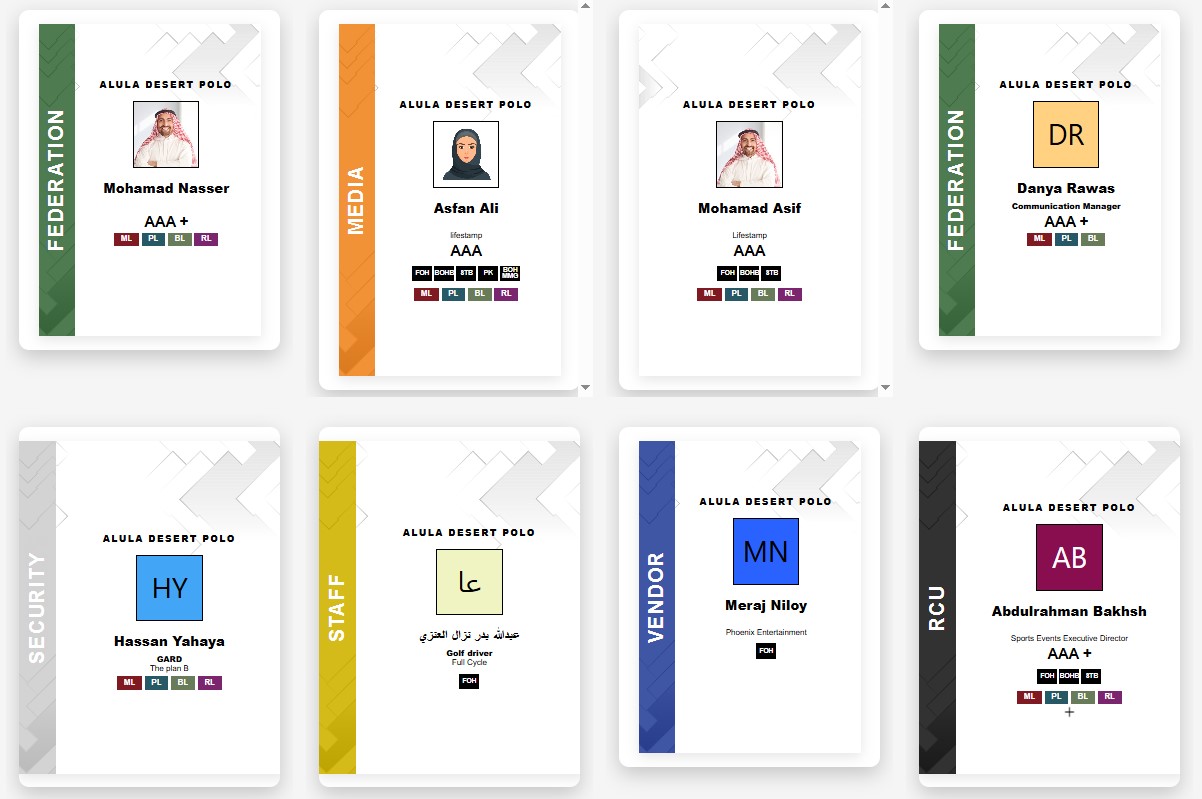
On-demand badge printing with automatic template selection by attendee category, RFID encoding, and full-colour personalisation.
Learn moreZone-Based Access Control
RFID or QR gate readers at each access point with real-time allow/deny decisions based on attendee credential permissions.
Learn moreReal-Time Analytics
Live dashboard showing attendance counts, zone occupancy, registration pace, and custom reporting for event organisers and sponsors.
Learn moreOn-Site Operations
Day-of execution is where event management plans are either validated or exposed. The most common operational failures — long queues at registration, badge errors, gate rejections — are all caused by decisions made weeks before the event opens. On-site operations are the execution of a plan, not the creation of one.
Event Day Pre-Opening Checklist
- Registration desk staffed and systems tested 2 hours before opening
- RFID print stations operational with pre-loaded attendee database
- All gate readers tested and confirmed green status on dashboard
- Walk-in registration workflow confirmed with on-site team
- UPS backup power active at all critical hardware stations
- Dedicated support line active for credential and access issues
- Security command centre briefed with zone capacity thresholds
- Void-and-reprint workflow confirmed with print station operators
Staff-to-attendee ratios:
For smooth registration, plan one print station per 200–250 attendees expected in the first hour. Staff each station with one operator at the desk and one at badge collection. For gate-only check-in (pre-printed or pre-issued badges), one reader per 400 attendees per hour is sufficient.
Post-Event Analysis
Post-event analytics are the most underutilised capability in Saudi event management. Most organisers collect registration data but never analyse attendance patterns, zone traffic, or peak hour distributions — missing the insights that would improve every subsequent event.
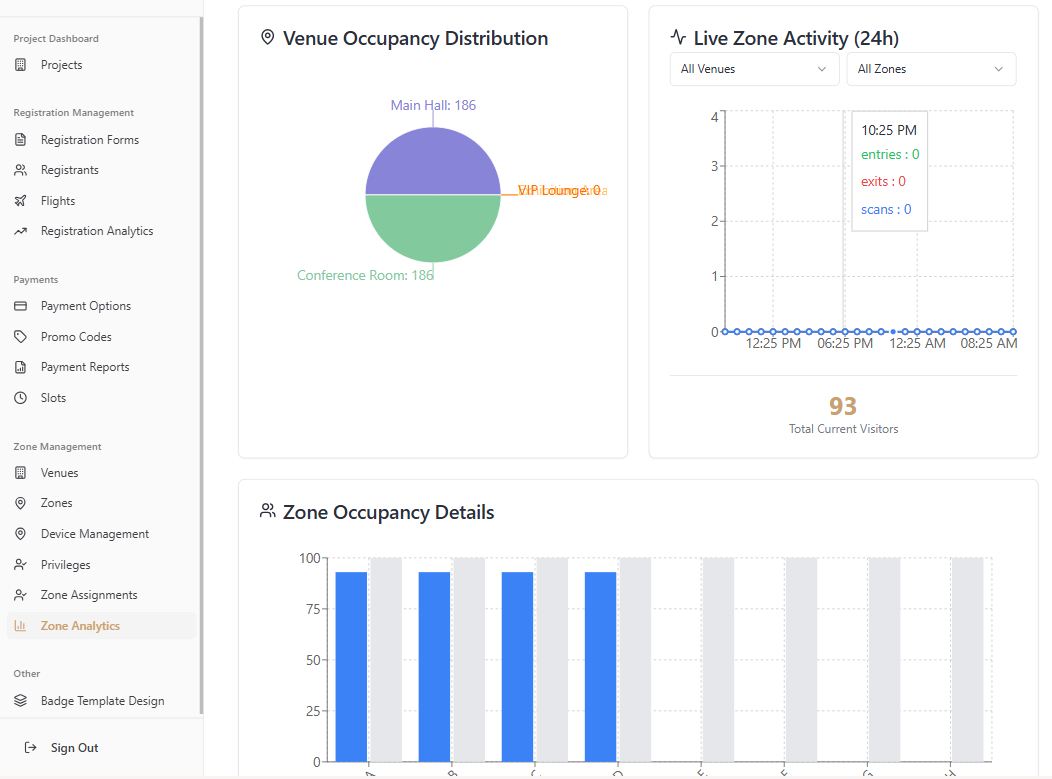
StampIQ's real-time dashboard generates a complete post-event report automatically — including actual vs. registered attendance, no-show rate by category, zone-by-zone traffic timeline, peak occupancy periods, and credential audit logs. Reports are available within 24 hours of event close and can be exported in multiple formats for sponsor and stakeholder reporting.
Attendance Report
Actual vs. registered, no-show rate, walk-in volume, by category
Zone Analytics
Traffic by access zone, peak occupancy, dwell time estimates
Audit Trail
Complete credential log with timestamps for compliance reporting
Frequently Asked Questions
Manage Your Next Saudi Event with StampIQ
StampIQ provides the complete event management technology stack — registration, accreditation, badge printing, access control, and analytics — for events across Saudi Arabia and the GCC.
Request a Demo