Saudi Arabia's event sector is growing at a rate that manual processes simply cannot sustain. The kingdom hosted over 11,000 licensed events in 2025 — from government conferences and cultural festivals to international trade shows. Behind every successful event is an operations team that is, quietly, losing the battle against spreadsheets, email chains, and manual badge distribution.
AI and automation are changing this — not by replacing event professionals, but by eliminating the administrative grind that consumes 40–60% of their time. The organizers who have adopted AI-powered platforms are handling larger events with smaller teams, making fewer errors, and spending more time on the high-value work that actually makes events exceptional.
This guide covers the six primary areas where AI and automation are transforming Saudi event operations, and provides a practical implementation roadmap for organizers ready to make the shift.
AI-Powered Event Operations — Impact by the Numbers
70%
Admin Time Saved
4×
Faster Registration
98%
Data Accuracy
40%
Cost Reduction
AI in Saudi Events: The Current Landscape
The adoption of AI in Saudi Arabia's events industry has accelerated dramatically since 2024. Vision 2030's emphasis on digital transformation has created both regulatory support and market demand for technology-first event operations. Government events now routinely mandate digital accreditation systems, and major venues are integrating smart crowd management tools as standard infrastructure.
The technology is no longer experimental. Saudi event organizers are using AI to solve concrete, day-to-day operational problems: accreditation backlogs, registration errors, badge misprints, and the inability to respond quickly to real-time events on the day. The six application areas covered in this guide represent where the clearest ROI is being measured.
Market context:
Saudi Arabia is investing SAR 150 billion in the events and entertainment sector through 2030. Events are becoming more complex, more frequent, and more international — and the operational bar is rising accordingly. Organizers who delay automation adoption are increasingly finding themselves outcompeted on both cost and attendee experience.
Registration Automation
Manual registration management is the single largest source of pre-event administrative work. For a 2,000-person conference, registration management can consume 40–80 staff-hours across the pre-event period: reviewing applications, sending confirmations, managing waitlists, processing payment confirmations, and chasing missing information.
Manual Registration Problems
- Data entry errors from manual form review
- Slow confirmation emails — sometimes 24–48 hrs
- Waitlist management requires constant monitoring
- Category assignment mistakes causing day-of access issues
- No real-time visibility into registration progress
Automated Registration Benefits
- Confirmations sent in seconds, not hours
- Smart forms that adapt based on attendee type
- Automatic waitlist management with instant notifications
- Category assignment from form data — no manual review
- Real-time dashboard showing registrations, completions, and trends
Smart Accreditation with AI
Accreditation — the process of verifying attendee identity and issuing access credentials — is the most complex manual process in event operations. For government and ministerial events in Saudi Arabia, accreditation can involve document verification, background check integration, and multi-level approval workflows.
Document Validation
AI cross-references submitted IDs against government databases and flags discrepancies automatically.
Category-Based Approval Routing
Applications are automatically routed to the correct approval authority based on attendee category — reducing review time by 60%.
Batch Processing
Groups of similar applications (e.g., all media applicants) are processed together with a single approval action.
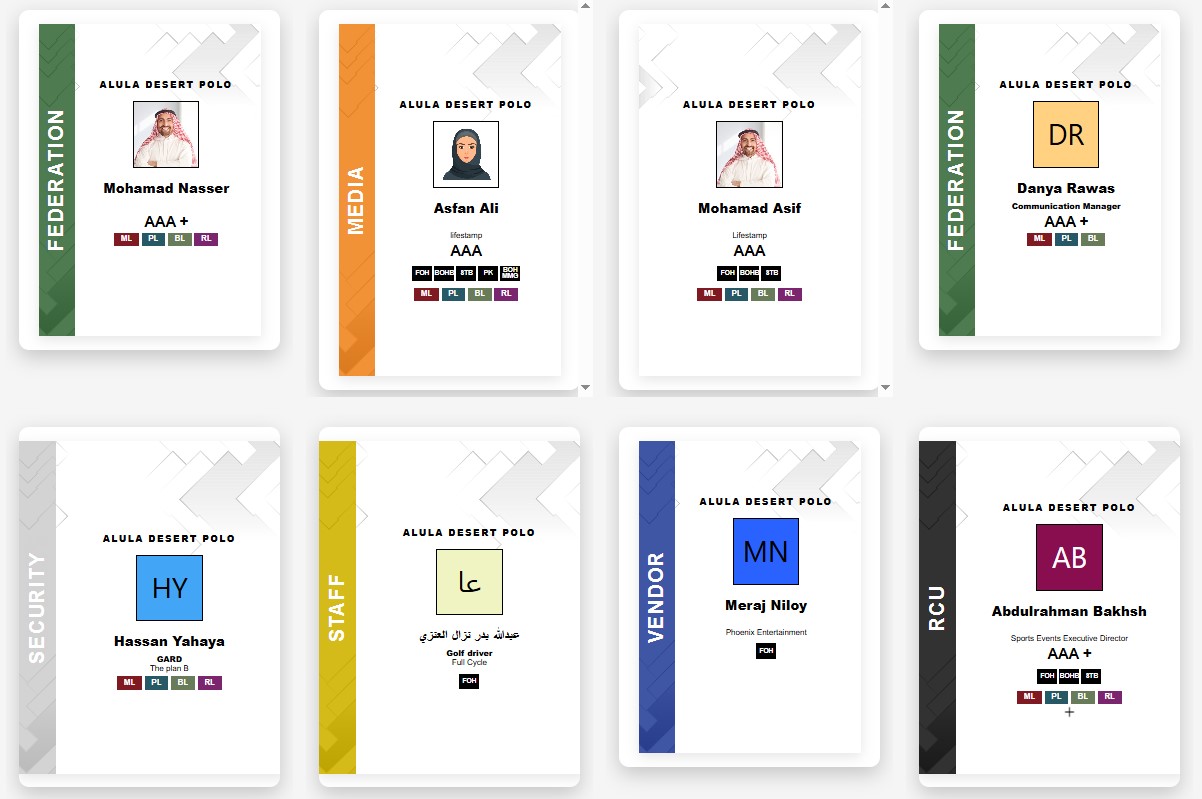
Automated Badge Generation
Approved applications instantly trigger badge design generation, ready for on-site printing at check-in.
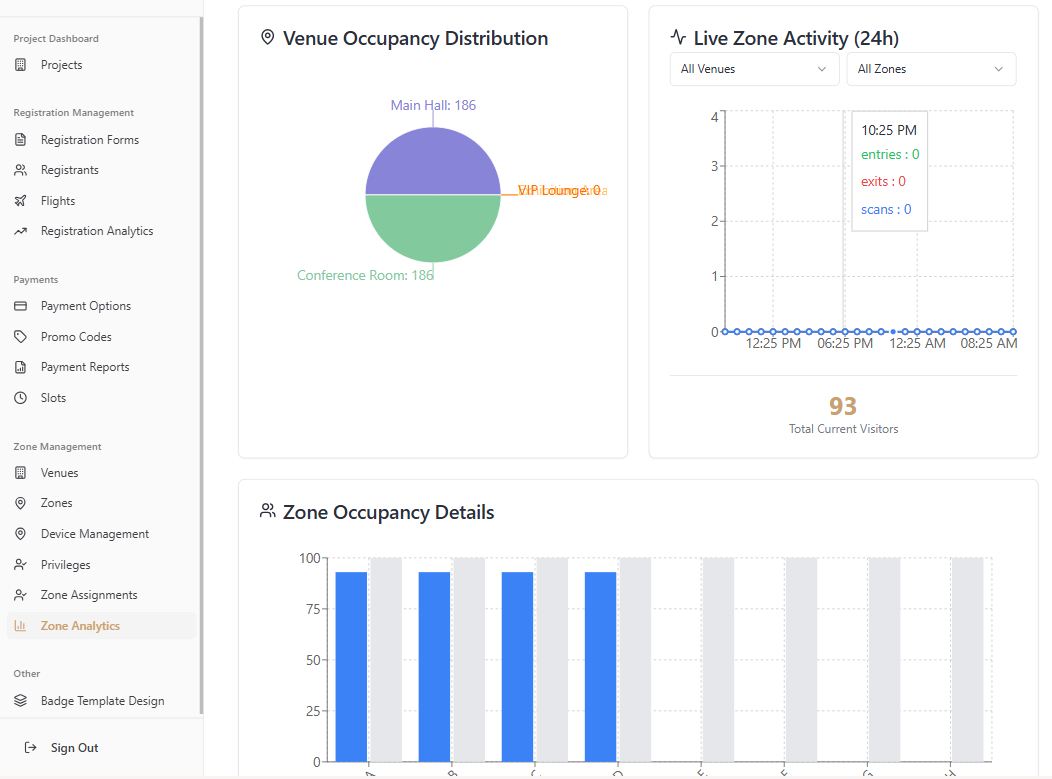
Real-Time Analytics Dashboards
Real-time analytics transform event operations from reactive to proactive. Instead of discovering a crowd bottleneck when attendees are already frustrated, analytics dashboards surface the problem when it is forming — giving operations teams a 5–10 minute window to intervene before it becomes critical.
Gate Throughput
Live scan/min per gate
Registration Funnel
Real-time completion rates
Session Occupancy
Live attendance per room
Crowd Density
Zone capacity vs actual
StampIQ's analytics dashboard aggregates data from RFID gates, registration forms, and badge print stations into a single operations view — accessible on any device, from the control room or from a supervisor's phone on the event floor.
AI-Powered Security
AI adds a layer of fraud detection and anomaly identification that manual security processes cannot replicate. For high-value events — ministerial summits, international conferences, royal-patronage events — this capability is increasingly critical.
Duplicate Detection
AI identifies duplicate registration attempts using fuzzy name matching, document similarity scoring, and device fingerprinting — catching registrations that share identity data but vary in formatting.
Anomaly Alerts
Unusual access patterns — a credential scanned at two gates simultaneously, a badge used 4 hours after its registered session ended — trigger automatic alerts to security supervisors.
Crowd Density Alerts
AI monitors zone occupancy in real time and triggers evacuation or capacity management alerts when preset thresholds are crossed — independently of human observers.
Automated Credential Voiding
When a security issue is identified, AI can automatically void affected credentials across all gates simultaneously — no manual update required at each reader.
Implementation Roadmap
The organizations that fail at AI adoption are usually those that try to automate everything at once. The ones that succeed start with one or two high-impact processes, prove the ROI, then expand. Here is the six-step roadmap StampIQ recommends for Saudi event organizers making their first serious investment in event automation.
Audit Your Current Manual Processes
Before implementing AI, map every manual step in your current event workflow — from registration form review to badge distribution to post-event reporting. Identify the 3–5 steps that consume the most staff time and have the highest error rate. These are your highest-ROI automation targets.
Select an Integrated Platform
Fragmented tools create integration complexity that negates automation benefits. Choose a platform like StampIQ that handles registration, accreditation, RFID access, and analytics in a single system. Data flows between modules automatically, eliminating manual export-import cycles between tools.
Configure Your Automation Rules
Define the logic that drives automated workflows: which attendee categories trigger which approval sequences, what email is sent at each registration stage, which data fields auto-populate from previous submissions, and what conditions trigger escalation to a human reviewer.
Run a Pilot Event
Deploy automation on a smaller internal event first. Measure actual time savings, identify edge cases the system cannot handle automatically, and refine your rules before applying the setup to a high-profile event. Most organisations find the first pilot reveals 2–3 process gaps they had not considered.
Train Your Team on Exception Handling
Automation handles the standard 80–85% of cases. Your team needs to be skilled at handling the remaining 15–20% that require human judgment — unusual credential requests, VIP access changes, late registrations outside system rules. Well-trained staff + well-configured automation = operational excellence.
Review Analytics Post-Event
AI generates value beyond the event itself. Post-event analytics reveal which sessions were underattended, where queues formed, which communication touchpoints drove the most registrations, and how check-in time varied across gates. Use this data to optimise every subsequent event.
Frequently Asked Questions
Ready to Automate Your Event Operations?
StampIQ's AI-powered platform handles registration, accreditation, access control, and analytics — so your team focuses on delivering exceptional events, not managing spreadsheets.
Request a Demo