Picture this: a VIP guest walks past a staff-only corridor and follows the crowd in. A media photographer wanders into a restricted athlete preparation area. A vendor without the right credential talks his way through a busy backstage checkpoint because the security officer cannot verify his badge fast enough.
These are not hypothetical problems. At large events without a proper zone access control system, they happen constantly — and each one is a security failure, a liability, and a reputational risk for the organiser.
Zone-based access control is the system that prevents this.
It divides the event venue into defined areas, assigns precise permissions to each attendee category, and enforces those permissions automatically at every checkpoint. StampIQ's zone access control system is deployed across events with up to 25 zones and tens of thousands of attendees — with 99.97% scan accuracy and zero reliance on human judgement at the gate.
This guide explains exactly what zone-based access control is, how it works, and how StampIQ implements it for events in Saudi Arabia and the GCC.
StampIQ Zone Control — By the Numbers
∞
Zones Per Event
<1s
Permission Propagation
99.97%
Scan Accuracy
0
Incidents at AlFursan
What Is Zone-Based Access Control?
Zone-based access control is a security system that divides a venue into distinct areas — called zones — and controls which people are permitted to enter each one based on their credential or badge type.
Each attendee has a credential (a QR code, RFID badge, or wristband) that carries their zone permissions. When they scan at a checkpoint, the system checks their permissions in real time and opens or refuses the gate. The decision happens in under half a second — without any human making a judgement call.
Zone-based access control answers one question at every checkpoint:
'Does this person have permission to be here right now?'
If yes — gate opens. If no — gate stays closed. No negotiation. No error.
Why Events Need Zone-Based Access Control
Not every event attendee should have access to every area. A general admission ticket does not entitle someone to the VIP hospitality suite. A media badge does not grant backstage access. A vendor credential does not open an athlete preparation room.
Without zone control, you are relying on security staff to remember who is allowed where — under pressure, in a crowd, with incomplete information. That is not a system. That is a guess.
The Risks of Manual Zone Management
- Unauthorised persons access restricted areas — VIP, press, backstage, secure zones
- Security staff cannot verify credentials fast enough at busy entry points, creating queues
- No audit trail — if a security incident occurs, there is no record of who was where and when
- Badge sharing is impossible to detect without automated logic
- Permission changes cannot be enforced consistently across all checkpoints
What Zone Control Solves
- Every access decision is automated — no reliance on individual staff judgement
- Permission changes take effect across all checkpoints within one second
- Full access log with timestamps for every scan, granted or denied
- Anti-passback logic prevents badge sharing at zone boundaries
- Capacity limits per zone enforced automatically
How StampIQ Implements Zone Access Control — Step by Step
Step 1 — Venue Mapping and Zone Architecture
Before any configuration begins, the StampIQ team conducts a full venue walkthrough. Every distinct area is identified and categorised: public zones, staff corridors, VIP areas, media zones, restricted operational spaces, and any area that requires controlled access.
Each zone is named, physically mapped, and assigned a security level. The number of zones is unlimited — StampIQ has deployed events with 8 zones (AlUla Desert Polo) up to 25+ zones for stadium-scale events.
Step 2 — Building the Permission Matrix
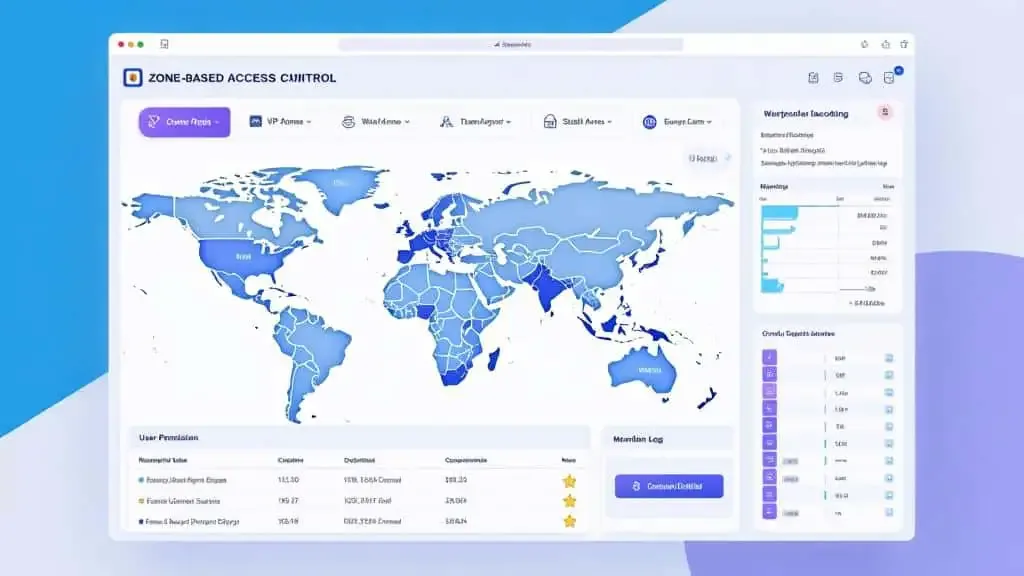
The permission matrix defines which credential category (attendee, VIP, media, staff, vendor, speaker, security) can access which zones. This is configured in the StampIQ dashboard before the event opens.
| Credential Type | Public | Media Zone | VIP Lounge | Backstage | Staff Only |
|---|---|---|---|---|---|
| General Attendee | ✗ | ✗ | ✗ | ✗ | |
| Media / Press | ✗ | ✗ | ✗ | ||
| VIP Guest | ✗ | ✗ | ✗ | ||
| Staff | ✗ | ✗ | ✗ | ||
| VIP Staff |
Step 3 — Hardware Deployment
QR scanners and RFID readers are installed at every entry point for every zone. StampIQ's devices support QR codes, RFID cards, NFC, and Bluetooth. Each device is synced to the live permission database and tested with real credentials before the event opens.
Hardware specifications relevant to event planners:
- Scan speed: under 0.5 seconds per credential
- Device user capacity: up to 85,000 unique credentials
- Offline operation: continues working if network drops, syncs on reconnection
- Door integration: automatically triggers gate or door opening on approved scans
Step 4 — Live Enforcement and Real-Time Monitoring
During the event, all scan activity flows into the StampIQ monitoring dashboard in real time via the real-time analytics service. The operations team can see which zones are filling up, which credentials have been scanned, and any access violations — all live, without needing to be on the ground.
If a badge is reported lost or a credential needs to be revoked, the operations team updates the permission in the dashboard. That change reaches every scanner across the entire venue within one second.
Key Features of StampIQ Zone Access Control
All features below are part of the zone-based access control service — available as a standalone deployment or integrated with the full StampIQ accreditation platform.
| Feature | What It Does |
|---|---|
| Unlimited Zones | No cap on the number of zones. Works for a 2-zone corporate event or a 25-zone stadium. |
| Real-Time Propagation | Permission changes and revocations reach all scanners within one second of saving. |
| Anti-Passback | Prevents badge sharing. A badge that has entered a zone cannot grant entry again until it exits. |
| Capacity Enforcement | Set a maximum occupancy per zone. Scanners automatically block entry when the limit is reached. |
| RFID & QR Support | Works with QR codes, RFID cards, RFID wristbands, and NFC. Mix technology types across zones. |
| Full Audit Trail | Every scan — granted or denied — is logged with timestamp, zone, credential ID, and operator ID. |
| Offline Mode | Scanning continues against a local cache if internet drops. All data syncs when restored. |
For high-throughput events using RFID wristbands, see: RFID Wristbands · Digital Badge Generation
Zone Control in Action — AlFursan Endurance AlUla
AlFursan Endurance AlUla (February 2026) was one of the most complex accreditation deployments StampIQ has managed. The event required two entirely separate credentialing tracks running in parallel across 6 distinct zones at the Mohamed Yousuf Naghi Equestrian Village.
Event Facts
- 10,000+ total attendees — 5,000 visitors and 5,000 vendors
- 6 access zones: paddock, press, VIP, participant areas, public grounds, operational areas
- Dual registration portals with separate approval workflows for visitors and vendors
- QR-coded badges with instant zone permission lookup at every entry point
- Dedicated StampIQ support team present across both event days
- Zero credential incidents recorded across all zones
The result: 10,000 people credentialed and managed across 6 zones over 2 days — with no queue incidents, no unauthorised access, and no system downtime.
Frequently Asked Questions
Talk to the StampIQ Team
Planning an event with multiple restricted areas?
StampIQ can configure zone-based access for your venue structure —
no matter how many zones, categories, or checkpoints you need.
Request a free consultation: stampiq.sa/services/zone-based-access-control